Why this unit
Process-type misclassification is a major source of downstream graph error.
Learning goals
- Distinguish axons and dendrites with morphology + organelle cues.
- Handle ambiguous edge cases with confidence scoring and continuity checks.
Core technical anchors
- Combined cue strategy: morphology, organelles, local connectivity.
- Edge cases: en passant boutons, thin dendrites, truncations.
- Auditability via confidence and correction logs.
Method deep dive: axon-vs-dendrite classification
- Morphology pass:
Branch caliber, tortuosity, spine presence, and process tapering.
- Organelle pass:
Vesicle clustering, microtubule patterning, mitochondrial distribution.
- Connectivity pass:
Input/output pattern and bouton/spine relationships in neighborhood.
- Continuity pass:
Validate interpretation along additional slices and branch points.
- Decision logging:
Capture confidence and alternative hypothesis if ambiguous.
Quantitative QA checkpoints
- Confusion matrix for axon/dendrite labels against adjudicated truth set.
- Error concentration map by tissue region and annotator.
- Rework fraction: percent of labels reversed during secondary review.
- Downstream sensitivity: impact of class errors on motif counts and graph metrics.
Frequent failure modes
- Thin dendrites mislabeled as axons:
Add local synaptic-role evidence before finalizing.
- Truncated field-of-view bias:
Mark as provisional when continuity evidence is missing.
- Bouton-centric bias:
Avoid relying only on vesicle presence without full context.
- Inconsistent team criteria:
Calibrate weekly with shared edge-case panels.
Visual training set (draft)
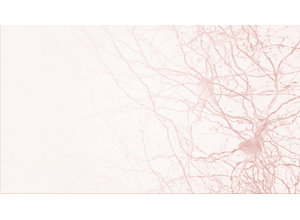
RIV-AXDEN S01: orientation figure for process-type comparison.
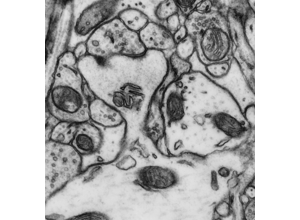
RIV-AXDEN S08: dendrite-focused morphology cue.
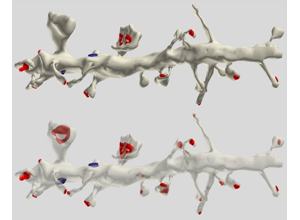
RIV-AXDEN S11: process classification cue in dense context.
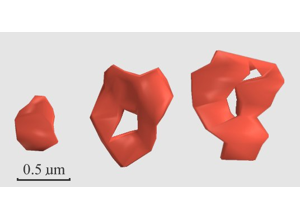
RIV-AXDEN S13: side-by-side axon/dendrite comparison panel.
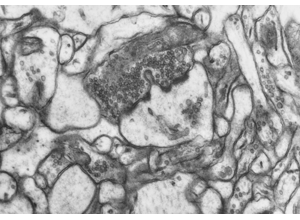
RIV-AXDEN S14: advanced feature set for ambiguity handling.
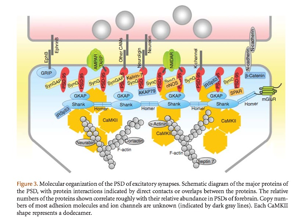
RIV-AXDEN S18: edge-case morphology requiring multi-cue interpretation.

RIV-AXDEN S22: high-complexity proofreading cue.

RIV-AXDEN S23: synthesis example for final class assignment.
Attribution: Pat Rivlin training materials (MICrONS proofreading deck). Some manifest-listed IDs used in planning (`S04`, `S06`, `S10`, `S16`) were not present in extracted thumbnails and were replaced with available neighboring cues.
Course links
Practical workflow
- Start with morphology cues.
- Add organelle and synaptic-context checks.
- Verify continuity in neighboring sections.
- Assign class with confidence and review note.
Discussion prompts
- Which edge cases most frequently produce classifier disagreement?
- How should teams calibrate confidence thresholds for class assignments?
Quick activity
Choose one ambiguous process and document the three strongest cues you used to classify it.
Draft lecture deck
