Why this unit
Reconstruction at connectome scale is a systems-engineering problem: alignment, storage, compute, orchestration, and reliability.
Technical scope
This unit treats connectome reconstruction as a production data platform problem: ingest, alignment, segmentation orchestration, object storage/indexing, provenance, and reproducible reprocessing.
Learning goals
- Describe architecture layers for large-volume reconstruction.
- Evaluate throughput, cost, and reproducibility tradeoffs.
- Design an end-to-end pipeline with explicit reliability and rollback strategy.
Core technical anchors
- Stitching/alignment/normalization pipelines.
- Multiresolution storage and APIs.
- Provenance/versioning and recovery workflows.
Visual context set (draft)

Module14 L1 S04: high-level architecture context.

Module14 L1 S07: workflow/API integration context.
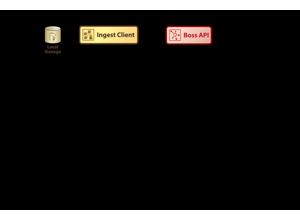
Module14 L1 S12: service decomposition context.

Module13 L1 S08: scalable analytics context.
Attribution: assets_outreach source decks (historical/context visuals).
Reference architecture
- Ingest layer:
Tile validation, checksum tracking, and immutable raw archive.
- Transform layer:
Stitching/alignment/normalization jobs with versioned parameter sets.
- Inference layer:
Segmentation/synapse models executed with tracked model hashes and runtime config.
- Post-processing layer:
Agglomeration, mesh/skeleton generation, and graph extraction.
- Serving layer:
Chunked multiscale volumes plus query APIs for analysis/proofreading.
Operational design details
- Orchestration:
Queue-based jobs with retry policies and idempotent stage outputs.
- Data layout:
Chunking strategy optimized separately for proofreading traversal and analysis queries.
- Versioning:
Every stage writes lineage metadata (input IDs, code revision, params, model artifact ID).
- Reprocessing:
Support partial invalidation (region-level) rather than full rerun by default.
Quantitative SLOs and QC
- Throughput SLO:
Target ingest/inference rates needed to meet project timeline.
- Reliability SLO:
Failure/retry rate and mean time to recovery per stage.
- Quality SLO:
Segmentation and synapse metrics tracked per release candidate.
- Cost envelope:
Compute and storage cost per cubic micron/cubic millimeter equivalent.
Failure modes and mitigation
- Hidden non-determinism:
Pin dependency versions and random seeds in production jobs.
- Provenance drift:
Reject outputs that do not include required lineage fields.
- Hotspot bottlenecks:
Monitor I/O and index saturation; rebalance chunking/index strategy.
- Unbounded reprocessing:
Implement region-scoped rollback and patch releases.
Course links
Practical workflow
- Define throughput and quality targets.
- Design ingest/alignment/storage components against those targets.
- Add versioning and provenance at each transform stage.
- Validate failure handling and reprocessing paths.
Discussion prompts
- Which architecture choices most improve reproducibility?
- What tradeoffs are acceptable between latency, cost, and fidelity?
Mini-lab
Draft a pipeline release plan that includes:
- Stage diagram with inputs/outputs.
- Three required provenance fields at each stage.
- Rollback strategy for a bad agglomeration release.
- One dashboard view with throughput, quality, and cost metrics.
Quick activity
Sketch a 4-stage reconstruction pipeline and mark where you would enforce provenance/version checkpoints.
Draft lecture deck
