Why this unit
Technical decisions depend on scale. Data representation, compute cost, and biological interpretation all shift from macroscale to ultrastructure.
Technical scope
This unit covers cross-scale reasoning from mesoscale maps to nanometer-resolution EM, including representation changes, registration assumptions, and how scale selection constrains valid biological claims.
Learning goals
- Separate modality scale from analysis scale.
- Plan scale-aware workflows and questions.
- Select a minimal sufficient scale for a target hypothesis and justify tradeoffs.
Core technical anchors
- Registration and coordinate consistency.
- Resolution anisotropy risks.
- Volumes, meshes, skeletons, and graphs as scale-dependent representations.
Visual context set (draft)

Module12 L1 S06: scale/voxel context.

Module12 L2 S04: macroscale pipeline view.
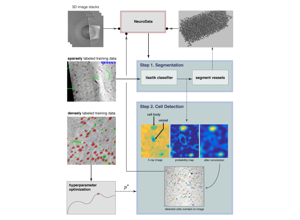
Module12 L2 S05: microscale/preprocessing bridge.

Module12 L3 S08: high-throughput imaging context.
Attribution: assets_outreach source decks (historical/context visuals).
Scale-aware data model
- Acquisition scale:
Voxel size, field of view, modality physics, contrast mechanism.
- Reconstruction scale:
Objects that can be reliably segmented (organelles, neurites, cells, tracts).
- Analysis scale:
Features extracted (motifs, cell-type distributions, connectivity statistics).
- Decision rule:
Choose the lowest-cost scale that still resolves all structures needed for your endpoint metric.
Method deep dive: cross-scale linkage
- Define anchor points across scales (landmarks, vasculature, layer boundaries, atlas coordinates).
- Register with transform provenance (rigid, affine, non-linear) and uncertainty estimates.
- Track anisotropy explicitly; avoid isotropic assumptions on anisotropic stacks.
- Build representations per stage:
- Volumes for raw inspection and alignment.
- Segmentations for object identity.
- Skeletons/meshes for morphology.
- Graphs for connectivity analysis.
- Propagate confidence across transforms so downstream users can see where uncertainty grows.
Quantitative quality gates
- Registration residuals reported per region, not only global averages.
- Sampling bias check across laminae/regions/cell classes.
- Representation fidelity checks (skeleton branch loss, mesh topology errors, graph edge uncertainty).
- Compute budget tracking: storage growth, I/O bottlenecks, query latency by scale.
Failure modes and mitigation
- Scale leakage:
Drawing fine-grained mechanistic conclusions from coarse data.
- Over-registration confidence:
Treating warped alignments as ground truth without local residual checks.
- Representation collapse:
Losing biologically relevant geometry during conversion to graph-only formats.
- Cost underestimation:
Ignoring downstream storage/index/query expansion when moving to higher resolution.
Course links
Practical workflow
- Define the target biological question.
- Select modality/scale that can resolve needed features.
- Estimate compute/storage implications.
- Plan cross-scale linkage and provenance.
Discussion prompts
- What is lost and gained when moving across scales?
- Which cross-scale assumptions most often fail in practice?
Mini-lab
Given a candidate question (“How cell-type-specific is local recurrent connectivity?”), produce:
- Required observable structures.
- Minimum voxel resolution and volume coverage.
- Registration strategy and validation metric.
- Final analysis representation and one expected bottleneck.
Quick activity
Pick a research question and propose the minimum data scale needed to answer it, including one tradeoff you accept.
Draft lecture deck
