Why this unit
Ultrastructure is the operational visual language of connectomics annotation and quality control.
Learning goals
- Identify core neuronal ultrastructural features in EM data.
- Apply context-aware interpretation with explicit uncertainty.
Core technical anchors
- Compartments: soma, dendrite, axon, bouton, spine.
- Cues: vesicles, PSD/active zone, mitochondria, ER, microtubules.
- Multi-slice context before final annotation decisions.
Method deep dive: compartment-level decision protocol
- Start with local geometry (diameter changes, branching pattern, cytoplasmic density).
- Add organelle evidence (microtubule organization, mitochondria morphology, vesicle fields).
- Evaluate synaptic architecture (active zone alignment, vesicle clusters, PSD profile).
- Confirm continuity across adjacent sections before committing label.
- Assign confidence tier (
high, medium, uncertain) with rationale.
Quantitative QA checkpoints
- Inter-annotator agreement on compartment labels.
- Synapse call precision/recall on a gold-standard subset.
- Uncertain-label rate by region as an indicator of dataset difficulty.
- Turnaround time per corrected ambiguity (captures workflow scalability).
Frequent failure modes
- Single-slice overconfidence:
Resolve only after short z-stack review.
- Organelle misread due to staining variability:
Use multi-cue voting instead of one-feature decisions.
- False synapse positives in noisy contrast:
Require structural context around candidate cleft.
- Label drift across long neurite paths:
Enforce periodic consistency checks during tracing.
Visual training set (draft)
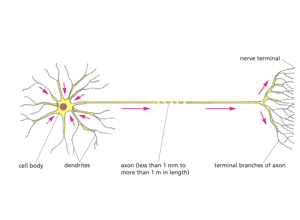
RIV-ULTRA S04: neuron-structure overview for compartment grounding.
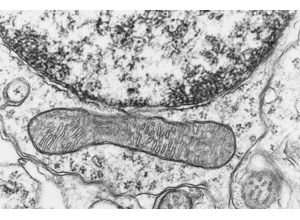
RIV-ULTRA S08: dendritic ultrastructure context.
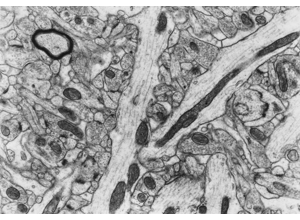
RIV-ULTRA S09: synapse-identification cue set.
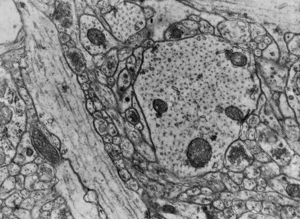
RIV-ULTRA S10: vesicle and organellar features relevant to annotation.

RIV-ULTRA S14: comparative ultrastructure panel.
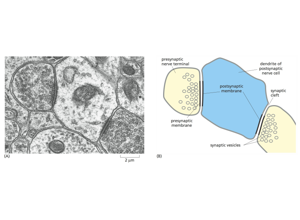
RIV-ULTRA S20: ambiguity case for context-aware interpretation.
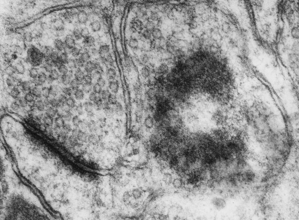
RIV-ULTRA S24: advanced structural example for review.

RIV-ULTRA S30: synthesis panel for final interpretation checks.
Attribution: Pat Rivlin training materials (MICrONS proofreading deck).
Course links
Practical workflow
- Localize candidate compartment and neighborhood context.
- Evaluate ultrastructural cues across adjacent slices.
- Assign provisional interpretation with confidence level.
- Escalate ambiguous cases for secondary review.
Discussion prompts
- Which ultrastructural cues are most robust across annotators?
- Where should uncertainty remain explicit rather than forced to a hard label?
Quick activity
Using one training image, label at least three ultrastructural cues and state your confidence for each interpretation.
Draft lecture deck
