Why this unit
Connectomics turns a broad scientific goal into a measurable technical program: map structure to generate testable hypotheses about function.
Technical scope
This unit defines what questions connectomics can answer, what it cannot answer alone, and how to convert biological motivation into a tractable reconstruction-and-analysis plan. The focus is on hypothesis framing, measurement targets, and evidentiary boundaries.
Learning goals
- Explain why structural maps matter for neuroscience and AI.
- Distinguish motivation from overclaim (structure informs, not alone explains, function).
- Write a technically testable connectomics question with measurable outputs.
Core technical anchors
- Circuit topology as a hypothesis engine.
- Comparative and developmental mapping.
- AI transfer through constraints and priors, not direct emulation.
Visual context set (draft)
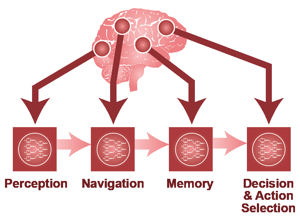
Techtalk S10: motivating question framing.
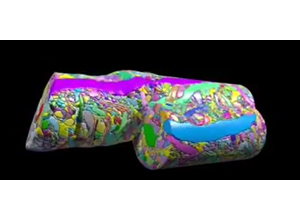
Techtalk S11: brain-data framing context.

Techtalk S12: reverse-engineering analogy and limits.

Module12 L1 S04: motivation and scope framing.
Attribution: neuroAI and outreach source decks (historical/context visuals).
Method deep dive: from question to measurable endpoint
- Start with a mechanistic question that has a structural signature (for example: recurrent microcircuit enrichment, axon targeting bias, cell-type-specific fan-in/fan-out).
- Define measurement units before touching data: synapse counts, motif frequencies, path lengths, compartment-targeting ratios, spatial gradients.
- Specify required reconstruction completeness (cell fragments, neurite-level, or near-complete local circuit) and acceptable error bounds.
- Choose inferential frame:
- Descriptive atlas output.
- Hypothesis test against null models.
- Comparative analysis across developmental stage/species/condition.
- Pre-register interpretation limits: structure can constrain possible computations, but does not by itself establish dynamic causal function.
Quantitative quality gates
- Annotation agreement: inter-rater agreement target for key labels before scaling.
- Reconstruction quality: minimum edge precision/recall requirements for the downstream claim type.
- Statistical validity: correction for multiple motif tests and transparent null-model choice.
- External validity: explicit statement of sampled region/species/age limits.
Failure modes and mitigation
- Vague question framing:
Convert broad goals (“understand intelligence”) into measurable structural hypotheses.
- Claim inflation:
Require each conclusion to cite both supporting metric and missing evidence.
- Metric mismatch:
Avoid using graph-level summary metrics when the hypothesis is local microcircuit-specific.
- Dataset mismatch:
Confirm acquisition scale and completeness actually support the claim.
Course links
Practical workflow
- Start with a concrete biological question.
- Identify what structural evidence could constrain that question.
- Map required data scale and workflow dependencies.
- Define limits of interpretation before drawing conclusions.
Discussion prompts
- What makes a brain-mapping goal technically actionable rather than aspirational?
- Where are the strongest boundaries between structural and functional claims?
Mini-lab
Draft one connectomics study brief with:
- Biological question.
- Structural measurements (at least three).
- Dataset requirements (resolution, volume, completeness).
- One null model and one key confound.
- One non-supported claim you will explicitly avoid.
Quick activity
Write one 2-3 sentence hypothesis that could be constrained by structural connectivity, and list one limitation of using structure alone.
Draft lecture deck
