Slide 1 of 21
 Nanoscale · Module 11
Synapses and Circuit Logic
Teaching Deck
Human cortex · H01
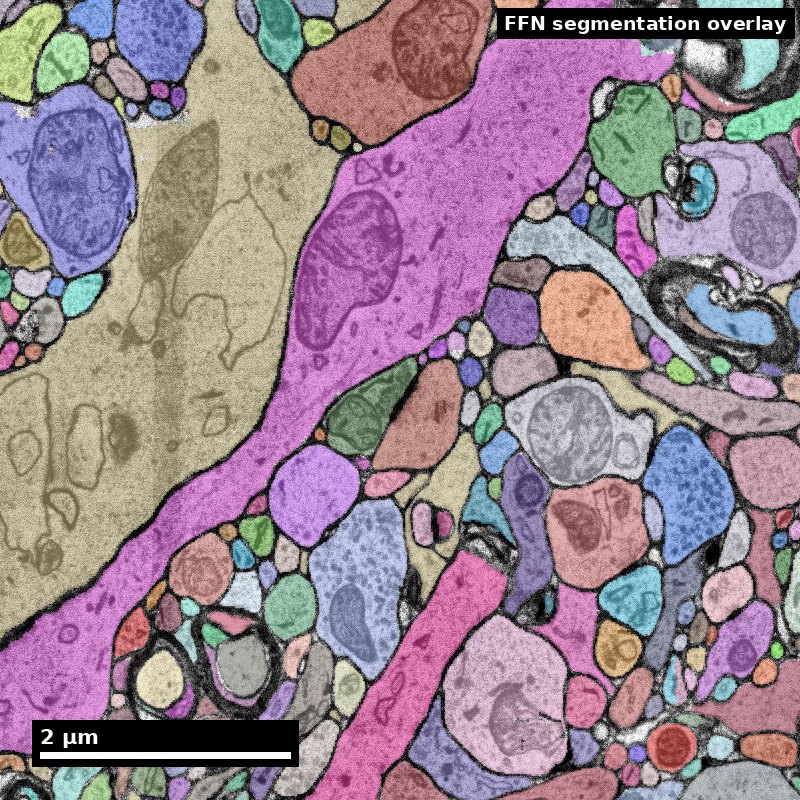
Object segmentation over electron microscopy
H01 release · Lichtman Lab / Harvard & Connectomics at Google · CC BY 4.0
Shapson-Coe et al. (2024) · doi:10.1126/science.adk4858
Slide 2 of 21
Learning Objectives
- Identify synaptic patterns relevant to circuit hypotheses
- Relate synapse-level observations to local motif logic
- Differentiate robust motifs from annotation artifacts
- Communicate circuit-level claims with explicit limits
Slide 3 of 21
Capability Target
Generate one synapse-to-motif interpretation with explicit evidence chain and one alternative explanation.
Slide 4 of 21
Concept Focus
1) Synaptic organization as circuit logic
Synapses are not randomly placed. Their location on the postsynaptic neuron (soma, proximal dendrite, distal dendrite, spine, axon initial segment) determines their functional impact:
- Perisomatic synapses (on soma and proximal dendrites): typically inhibitory (basket cells), powerful because they're close to the spike initiation zone. These synapses can veto spiking.
Slide 5 of 21
Concept Focus (continued)
- Dendritic spine synapses: typically excitatory, the workhorses of cortical computation. Each spine receives one (usually) excitatory synapse. Spine size correlates with synapse strength — larger mushroom spines have larger PSDs and more AMPA receptors.
- AIS synapses: exclusively from chandelier cells. The only inhibitory input at the axon initial segment, positioned to control spike generation directly.
- Shaft synapses on smooth dendrites: typically inhibitory-to-inhibitory connections (disinhibition circuits) or excitatory inputs onto aspiny interneurons.
Slide 6 of 21
Core Workflow
- Identify synapse candidates: find synapses in the region of interest with correct pre/post assignment.
- Build local connectivity motif: extract the subgraph connecting the pre and post neurons and their immediate neighbors.
- Classify the motif: reciprocal pair, feed-forward loop, feedback inhibition, convergent input, etc.
- Evaluate against null: is this motif more common than expected?
Slide 7 of 21
Core Workflow (continued)
- State supported claim (what the data shows) + caveat (what it doesn't prove and what could confound it).
Slide 8 of 21
Run of Show (60 min)
- 00:00-10:00 | Synapse cue recap
- 10:00-24:00 | Motif construction examples
- 24:00-38:00 | Learner motif analysis
- 38:00-50:00 | Alternative explanation challenge
Figure description and teaching notes
Pre-class preparation (10 min async)
Review the synapse classification content library entry (Gray Type I/II)
Review the motif analysis content library entry (key motif types section)
Minute-by-minute plan
00:00-10:00 | Synapse cue recap
Quick review: asymmetric (Type I, excitatory) vs symmetric (Type II, inhibitory) synapses.
Show 3 synapses in EM: spine synapse, perisomatic synapse, AIS synapse. "Where the synapse lands tells you about circuit function."
10:00-24:00 | Motif construction examples
Walk through 3 motifs in the MICrONS dataset:
Reciprocal pair between two L2/3 pyramidal cells (mutual excitation)
Feed-forward loop: L4 stellate → L2/3 pyramidal → L5 pyramidal, with L4 also connecting directly to L5
Feedback inhibition: pyramidal → basket cell → same pyramidal
For each: show the EM evidence (synapses), draw the circuit diagram, discuss functional implication.
24:00-38:00 | Learner motif analysis
Learners receive a small subgraph (15 neurons, 50 synapses) and identify all 3-node motifs.
Count each motif type. Which are most common?
Compare to expectations: "If these were randomly connected with the same degree distribution, how many of each motif would you expect?"
38:00-50:00 | Alternative explanation challenge
For each enriched motif, learners must propose one alternative (non-functional) explanation:
"Reciprocal connections are enriched because nearby neurons are more likely to connect" (spatial proximity)
"Feed-forward loops are enriched because of cell-type structure" (E→I and I→E are common)
Group discussion: how would you test whether the spatial explanation is sufficient?
50:00-60:00 | Competency check
Each learner writes a motif claim/caveat pair:
"In this circuit, [motif] is enriched [X]× compared to [null model]. This is consistent with [functional interpretation]. However, [alternative explanation] could also account for this enrichment."
Exit ticket: "One motif claim and one plausible confound."
Slide 9 of 21
Run of Show (60 min) (continued)
- 50:00-60:00 | Competency check
Slide 10 of 21
Misconceptions to Watch
- Misconception guardrail: asymmetric morphology means a synapse is excitatory, rather than putatively excitatory under a stated assumption.
- Misconception guardrail: reconstruction errors add symmetric noise to motif counts, when merges bias them toward denser motifs.
- Misconception guardrail: a motif observed more often than expected is a functional building block.
- Misconception guardrail: synapse count is a direct measure of connection strength rather than a proxy for it.
Slide 11 of 21
Studio Activity
Scenario: You are analyzing a 200-neuron subgraph from the MICrONS dataset, spanning L2/3 and L4 of mouse visual cortex. Your goal: characterize the local circuit motif profile and identify any enriched patterns that suggest specific wiring rules.
Slide 12 of 21
Activity Output Checklist
- Evidence-linked artifact submitted.
- At least one limitation or uncertainty stated.
- Revision point captured from feedback.
Slide 13 of 21
Assessment Rubric
Minimum pass
- The motif count table reports observed, expected, and z-score for every motif class examined, not only the enriched ones.
- At least one motif carries a complete evidence chain: detection method, count, null comparison, and interpretation, in that order.
- Each claim in the circuit logic brief is paired with an explicit caveat stating what it does not prove.
Slide 14 of 21
Assessment Rubric (continued)
- The synapse threshold and data version used to build the subgraph are stated in the brief.
Slide 15 of 21
Assessment Rubric
Strong performance
- Every enriched motif has at least one non-functional alternative explanation (spatial proximity, cell-type composition, reconstruction error) named and, where possible, tested.
- A second null model or a stratified analysis is applied to at least one motif, with the change in effect size reported.
Slide 16 of 21
Assessment Rubric (continued)
- Synapse-level evidence — compartment targeting, Gray type — is used to subdivide or qualify at least one motif class rather than treating graph edges as interchangeable.
- Sensitivity to reconstruction quality is quantified: the headline count is re-run at a second synapse threshold or across proofreading versions, and the difference is reported.
Slide 17 of 21
Assessment Rubric
Common failure to flag
- Motif claim without error-awareness — treating every enriched pattern as a functional circuit without considering artifacts or spatial confounds.
- Functional language ("this circuit gates," "this loop amplifies") presented as a finding rather than as a consistency statement.
- Enrichment reported against a single weak null with no statement of what it fails to control.
Slide 18 of 21
Exit Ticket
Write one motif claim and one plausible confound.
Slide 19 of 21
References (Instructor)
- Use module references listed on the module page.
Slide 20 of 21
Teaching Materials
- Module page: /modules/module11/
- Session kit: /teaching/sessions/module11/
- Worksheet: /assets/worksheets/module11/module11-activity.md
Slide 21 of 21
Read, review, or teach
The reading version includes figure descriptions and discussion guidance.
Nanoscale text: CC BY 4.0. Scientific figures retain their individual credits.